The Complete Guide to Wildlife Photography
Part 1 - Best Wildlife Photography Camera Settings
This is the first post in a multi-part series on wildlife photography. If you’re new here, welcome to my blog!
For this very first post, we’re going to review the camera settings you should use when photographing wildlife. This is going to differ for every wildlife photographer because each photographer has their own shooting style. My best piece of advice is to get out, shoot, and see what works best for your shooting style!
In my opinion, to photograph fast-moving wildlife no matter the setting, you will want a fast shutter speed. A ‘fast’ shutter speed varies, but I would start at no slower than 1/500th of a second. The table below is a good example of how to set your camera up depending on the wildlife you’ll be photographing.
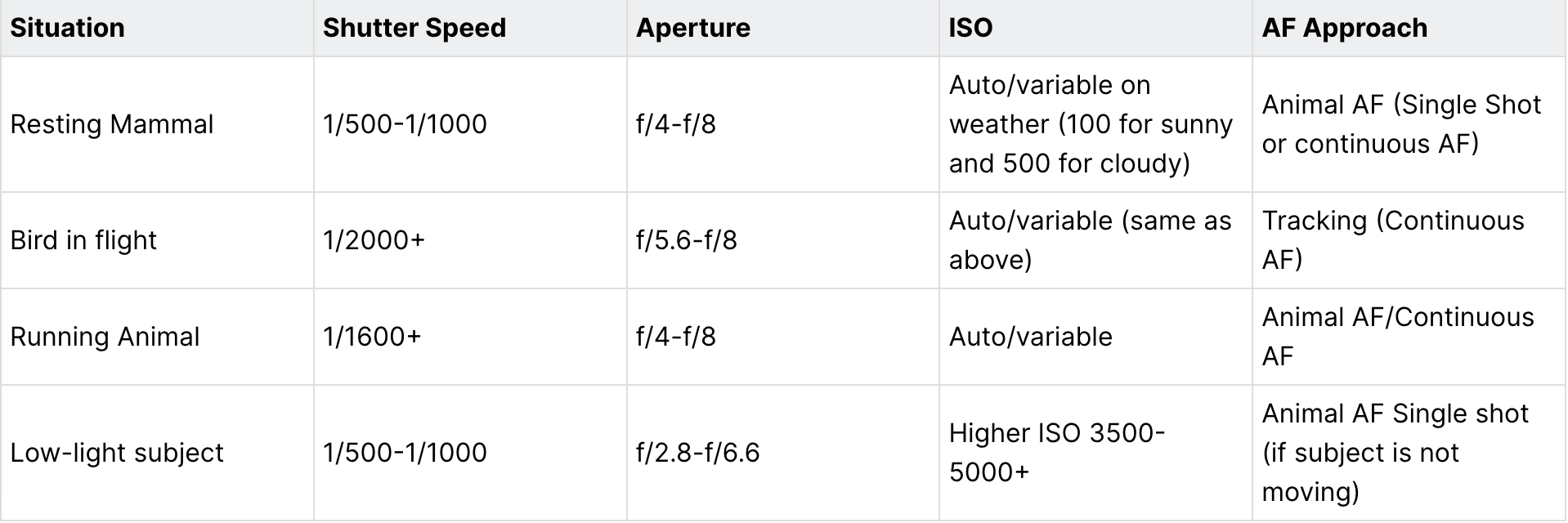
As you can see from the table above, there are varying settings for each of the things you’ll be photographing. My recommendation is always to have the lowest ISO possible for the animal you are shooting. However, a trick I’ve learned that has helped me become a better wildlife photographer is to shoot in auto ISO. This might seem counterintuitive, but when you are in the field photographing animals, seconds count. You might end up in a situation like the one I was in while photographing a grizzly bear in Grand Teton National Park, where my settings weren’t right, and I had seconds to change them before I lost the bear. Though I encourage you to learn and shoot in manual mode, having your ISO set to auto can save your butt.
Another pro of shooting on auto ISO is that it lets you focus on one less thing while you’re out in the field. Focusing on your f-stop and your shutter speed can be your top priority, eliminating one more stressor.
The lowest aperture setting is best for photographing wildlife and for achieving creamy drop-off backgrounds in your images. When you’re looking for more environmental portraits of wildlife, you’re going to want your f-stop to be around f8 or higher. That allows more background to be in focus while photographing your subject.
Hopefully, this helps you as you work on your wildlife photography journey!
